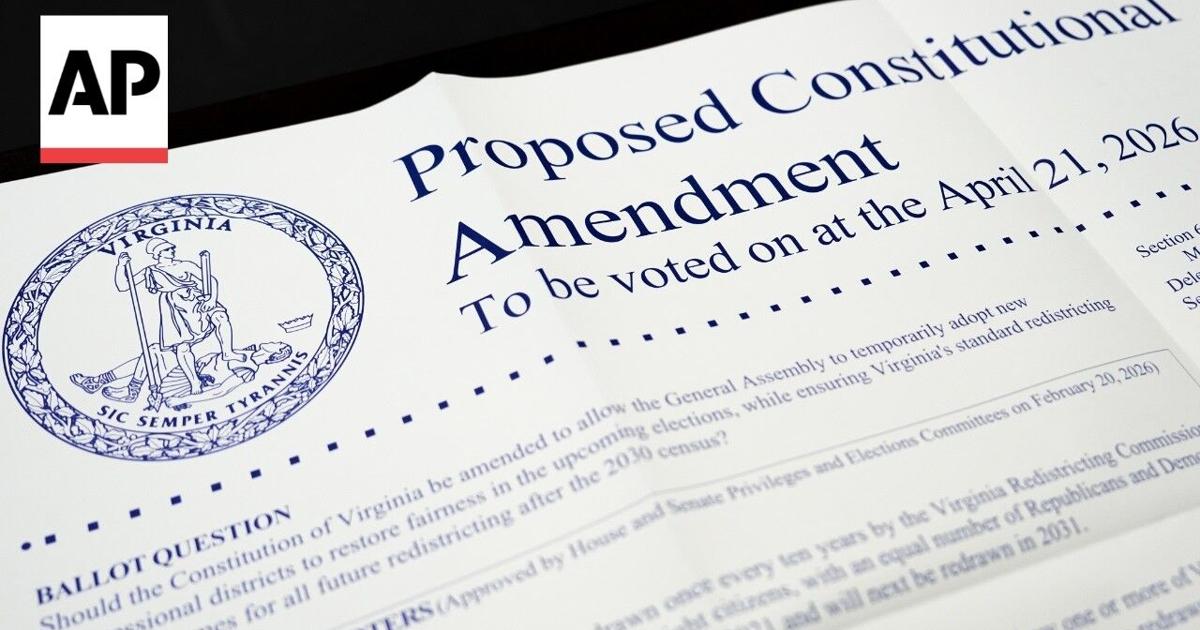
A voter-approved congressional map that gives Democrats a structural advantage now sits under judicial review, as the Virginia Supreme Court weighs whether to block it. The case cuts to the core of democratic fairness, constitutional interpretation, and the role of courts in policing politically skewed maps—even when those maps emerge from public referendums.
Unlike typical gerrymandering cases where a legislature or partisan commission draws skewed lines, this map was approved directly by voters through a ballot initiative. Yet its outcome—a likely delegation of 7 Democrats to 3 Republicans in the U.S. House, despite a nearly even statewide partisan split—has ignited legal and political controversy. Critics argue the map undermines competitive elections, while supporters say it reflects democratic will and racial equity.
This isn’t just about party advantage. It’s a constitutional test of how Virginia interprets its own redistricting reforms and whether voter approval can legitimize maps with lopsided partisan outcomes.
The Origins of Virginia’s Redistricting Overhaul
Virginia’s current redistricting drama didn’t emerge in a vacuum. For decades, the state’s legislative and congressional maps were routinely manipulated by whichever party held power. Republicans dominated the process for much of the early 2000s, drawing safe seats that endured even during Democratic waves. By 2020, frustration boiled over.
In response, voters approved a constitutional amendment creating the Virginia Redistricting Commission. The goal was clear: remove partisan cartographers from the process and create fairer maps through citizen input and transparency. The commission—composed of eight legislators and eight citizens—was tasked with drawing both state legislative and congressional districts.
But the process faltered. The commission deadlocked along partisan lines, failing to produce a final map. Under the amendment’s fallback provisions, the task fell to the Supreme Court of Virginia, which selected a map proposed by a special master. That map, while court-drawn, leaned Democratic in its design—particularly by heavily packing Republican voters in rural western Virginia and consolidating Democratic strength in urban and suburban hubs like Northern Virginia and Richmond.
How the Map Favors Democrats
The current congressional map creates a 7D-3R delegation under typical voting conditions, despite Virginia’s statewide vote in recent federal elections being within 5–7 points of parity. That imbalance stems from specific design choices:
- Cracking and Packing in the Shenandoah Valley: The 6th District, once a GOP stronghold, is redrawn to stretch from Roanoke to the edge of Charlottesville, incorporating more moderate and college-educated voters. This dilutes conservative strength.
- Consolidation of Northern Virginia: The 8th and 10th Districts—anchored in Arlington, Alexandria, and Fairfax County—are made even more reliably Democratic, merging high-turnout Democratic enclaves.
- Creation of Minority-Opportunity Districts: The 4th District, anchored in the I-95 corridor from Richmond to Petersburg, was redrawn to increase Black voter influence. While this satisfies Voting Rights Act standards, it also removes competitive terrain from adjacent districts.
Political analysts estimate that Republicans would need to win the statewide vote by 8–10 points to secure a majority of Virginia’s House delegation under this map—virtually impossible in today’s polarized landscape.
Legal Challenges to the Voter-Approved Map
Despite coming from a court-appointed special master and being finalized through a constitutional process, the map faces multiple legal challenges. Opponents, primarily conservative groups and Republican voters, argue it violates Virginia’s Constitution, which prohibits districts from being drawn “for the purpose of favoring or discriminating against a political party.”
The key legal question: Can a map be unconstitutional even if it was indirectly approved by voters?
Plaintiffs contend that the special master’s map was crafted with partisan intent—favoring Democratic incumbents and protecting vulnerable seats. They argue that the court, by adopting the map, exceeded its role as a neutral arbiter and effectively engineered a partisan outcome.
Supporters counter that the map complies with all state and federal requirements: it’s contiguous, respects municipal boundaries where possible, and creates two minority-opportunity districts. They also emphasize that the Supreme Court didn’t draw the map itself but relied on an independent expert after the commission failed.
“The people’s will was honored when they approved the redistricting amendment,” said one constitutional law professor at UVA. “But that doesn’t mean courts can abdicate their duty to enforce constitutional limits on partisanship.”
What’s at Stake for Virginia’s Democracy
Beyond immediate partisan outcomes, this case could redefine how Virginia balances voter participation with judicial oversight.
If the Supreme Court upholds the map, it sets a precedent that court-selected maps—even those with clear partisan effects—can stand if they follow procedural rules. But if the court strikes it down, it could invalidate not just this map but also future interventions, creating a vacuum in the event of future commission failures.
There are broader implications for trust in the redistricting process. If citizens believe commissions and courts are just partisan proxies, faith in democratic institutions erodes. On the other hand, allowing maps that lock in one-party advantage risks complacency and uncompetitive elections.
One practical consequence: campaign strategies will shift dramatically based on the ruling. Democratic campaigns may focus resources on Senate or statewide races, assuming House seats are safe. Republicans, already struggling to recruit candidates in “unwinnable” districts, could face deeper bench shortages.
Past Precedents and Judicial Leanings
Virginia’s Supreme Court has undergone a quiet transformation. Once reliably conservative, the court now has a 5–2 Democratic majority following judicial appointments in recent years. That shift may influence how justices interpret the anti-gerrymandering clause.
Notably, in 2023, the court upheld a previous congressional map that also leaned Democratic, ruling that while partisan effects existed, there was insufficient evidence of intent to discriminate. That precedent looms large.
But this case is different. The earlier map was challenged immediately after adoption. This one comes after a full election cycle, giving plaintiffs more data on electoral outcomes. They now argue that real-world results prove the map entrenches Democratic power.

Legal experts watching the case say the justices may look for a narrow ground to avoid overturning the map—such as remanding it for minor adjustments—rather than invalidating it entirely and risking election chaos.
Practical Implications for Voters and Candidates For Virginia voters, the outcome affects more than who represents them in Congress. It shapes how accountable their representatives feel.
In heavily gerrymandered districts, incumbents often focus on primary challenges rather than general election competition. A Democrat in the 10th District, for example, may worry more about a progressive activist than a GOP challenger. This can pull policy positions further from the center.
Candidates face real strategic dilemmas: - Running in a “safe” district may offer a higher chance of winning but less influence in a narrowly divided Congress. - Potential Republican candidates in maps like the current 5th or 7th District may decline to run, seeing fundraising and polling hurdles as insurmountable.
Local parties could respond by investing more in down-ballot races—state legislature, school boards, county supervisors—where competition remains viable. But that risks further disconnect between federal representation and voter engagement.
What a Block Would Mean for Future Redistricting
Should the Virginia Supreme Court block the current map, the state would need to revert to an older version or create a new one ahead of the next election. Given the timeline, that could mean either: - Reinstating the 2017 congressional map (which had a 6–4 Republican advantage and was later struck down for racial gerrymandering), or - Commissioning a new special master to draft an alternative.
Either option creates uncertainty. Reverting to an older map could face its own legal challenges. Designing a new one under time pressure risks procedural flaws.
More importantly, a reversal could signal that even court-adopted maps aren’t immune to judicial second-guessing. That might discourage future special masters from proposing bold designs, leading to more conservative, compromise-based maps that avoid controversy but fail to correct past imbalances.
Final Arguments and the Road Ahead
The Virginia Supreme Court’s decision will hinge on interpretation: Is the anti-partisanship clause a strict rule or a guiding principle? Does voter approval of the redistricting system imply acceptance of its outcomes—even lopsided ones?
Oral arguments have highlighted deep philosophical divides. Some justices questioned whether courts can—or should—measure partisan fairness with precision. Others pressed whether ignoring clear Democratic advantage undermines the Constitution’s intent.
No ruling is expected before late fall, but the timing is critical. Delays could disrupt candidate filing deadlines and voter education efforts for the next federal election.
Whatever the outcome, one truth remains: Virginia’s experiment in democratic redistricting has exposed the limits of reform. Processes matter, but so do outcomes. And when outcomes feel rigged—even through lawful means—democracy pays the price.
The court’s decision won’t end the debate over fair maps. But it will define whether Virginia’s redistricting model survives its first real crisis—intact, revised, or abandoned.
FAQ
What should you look for in Virginia Supreme Court Weighs Fate of Democratic-Favored House Map? Focus on relevance, practical value, and how well the solution matches real user intent.
Is Virginia Supreme Court Weighs Fate of Democratic-Favored House Map suitable for beginners? That depends on the workflow, but a clear step-by-step approach usually makes it easier to start.
How do you compare options around Virginia Supreme Court Weighs Fate of Democratic-Favored House Map? Compare features, trust signals, limitations, pricing, and ease of implementation.
What mistakes should you avoid? Avoid generic choices, weak validation, and decisions based only on marketing claims.
What is the next best step? Shortlist the most relevant options, validate them quickly, and refine from real-world results.