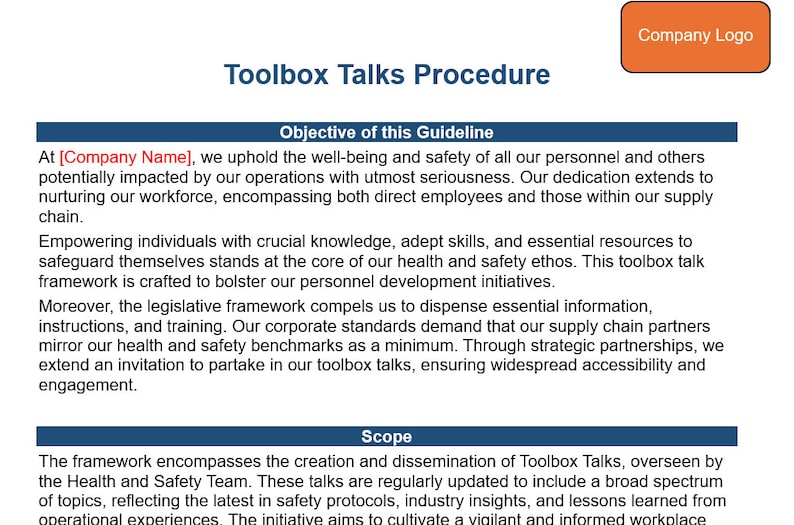
Too many toolbox talks are rushed, repetitive, or forgotten by mid-morning. Workers zone out. Supervisors read from memory. No one retains the message. The cost? Increased risk, inconsistent safety practices, and fragile compliance.
But when structured around strong template toolbox talk examples, these short safety meetings become powerful tools. They standardize critical messaging, save planning time, and increase retention. More importantly, they turn safety from a formality into a habit.
This guide delivers actionable template toolbox talk examples—not theoretical frameworks. You’ll learn how to adapt them, avoid common pitfalls, and make safety stick across your team.
What Makes a Good Toolbox Talk Template
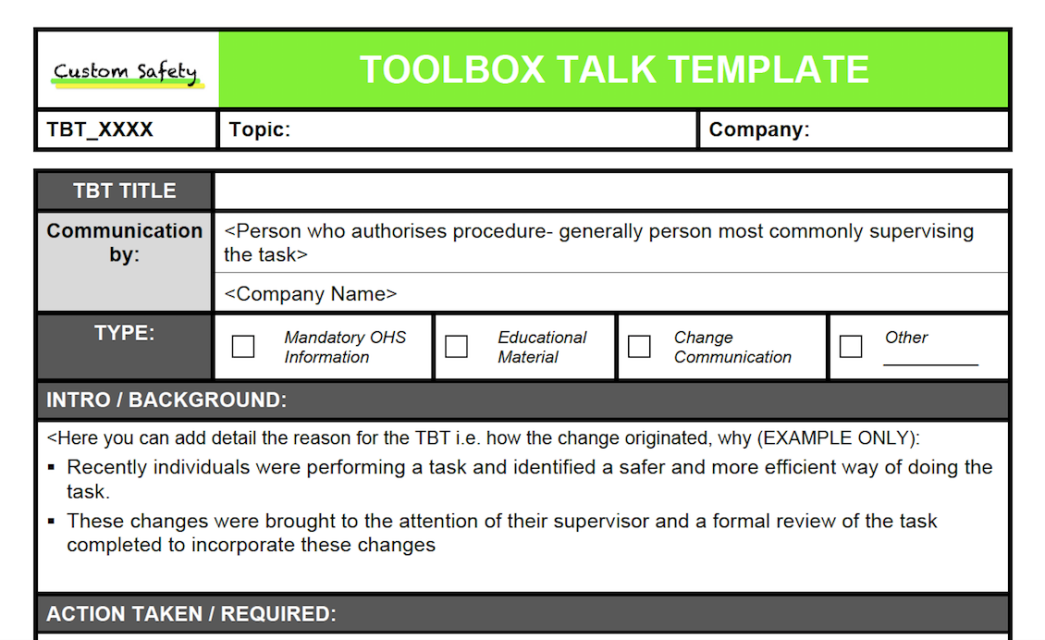
A template isn’t just a fill-in-the-blank form. It’s a strategic framework that ensures consistency while allowing for real-time relevance. The best ones include:
- Clear topic focus (e.g., ladder safety, not just “general safety”)
- Real-world hazard examples workers actually face
- Discussion prompts that engage the team
- Sign-off section for attendance and verification
- Visual cues or diagrams where helpful
Poor templates list bullet points without context. Strong ones prompt dialogue. For example, instead of writing “Always wear PPE,” a better prompt is: “What PPE did someone forget this week—and what could’ve gone wrong?”
Top 5 Template Toolbox Talk Examples You Can Use Today
Below are five proven template toolbox talk examples—realistic, adaptable, and field-tested in construction, maintenance, and industrial settings.
1. Fall Protection on Elevated Work Surfaces
Hazard Focus: Working at heights above 6 feet Duration: 8–10 minutes
Key Talking Points: - Inspect harnesses and lanyards before use - Anchor points must support 5,000 lbs - No "just for a minute" unhooking
Discussion Prompt: “Has anyone seen someone bypass fall protection recently? What stopped them—or what didn’t?”
Action Step: Each worker checks their harness attachment before the shift.
⚠️ Real Mistake: A roofer removed his lanyard to move 10 feet. Slipped. Result: 3 weeks off, $42K in claims.
2. Electrical Safety Around Overhead Lines
Hazard Focus: Contact with live power lines Duration: 7–9 minutes
Key Talking Points: - Maintain 10-foot clearance from all overhead lines - Assume all lines are live - Use spotters when operating cranes or booms
Discussion Prompt: “What would you do if a crane operator started moving near a power line?”
Action Step: Mark high-risk zones on site maps and review daily.
⚠️ Real Mistake: A worker used a metal pole near a 7,200V line. Instant electrocution. No spotter assigned.
3. Safe Lifting Techniques (Manual Handling)
Hazard Focus: Back injuries from improper lifting Duration: 6–8 minutes
Key Talking Points: - Bend knees, keep back straight - Test weight before lifting - Get help for loads over 50 lbs
Discussion Prompt: “Show me how you’d lift a 60-lb box from a pallet.”
Action Step: Use team lifts or mechanical aids for heavy items.
⚠️ Real Mistake: A plumber lifted a water heater alone. Herniated disc. Case filed.
4. Hot Work and Fire Prevention
Hazard Focus: Welding, cutting, grinding near flammables Duration: 10 minutes
Key Talking Points: - Clear combustibles within 35 feet - Fire watch for 30 minutes post-work - Valid hot work permit required
Discussion Prompt: “What counts as a ‘hidden’ fire risk—like insulation or dust buildup?”
Action Step: Assign fire watch duty daily on hot work days.
⚠️ Real Mistake: Welding near painted wood. Smolder started, caught fire 45 minutes later.
5. PPE Audit and Accountability
Hazard Focus: Inconsistent PPE use Duration: 6 minutes
Key Talking Points: - Hard hats, safety glasses, gloves—non-negotiable - Replace damaged or expired gear immediately - Supervisors must enforce, not just remind
Discussion Prompt: “Who on your team consistently skips safety glasses? Why?”
Action Step: Conduct a 2-minute PPE check at shift start.
⚠️ Real Mistake: A worker lost an eye from flying debris. He’d removed his glasses “for a second.”
How to Customize Templates Without Losing Impact
Templates only work if they’re not robotic. Here’s how to adapt them without sacrificing quality:
Tailor to Your Crew’s Language Avoid OSHA jargon. Say “watch your step” instead of “maintain three points of contact.” Workers respond to real talk.
Add Site-Specific Hazards If your team works in wet conditions, modify the electrical safety talk to include “wet surface risks.”
Rotate Topics Monthly Use a 12-week safety calendar. Avoid repeating the same talks every month—workers disengage.
Include a “Near Miss” Story Start with: “Last week, a worker almost fell through a skylight. Here’s how we stop it.” Stories stick.
Use Visual Aids Print a photo of a damaged harness. Hold up a torn glove. Visuals increase retention by 65%.
Common Mistakes When Using Toolbox Talk Templates
Even the best templates fail when misused. Here are the top errors and how to fix them:

| Mistake | Consequence | Fix |
|---|---|---|
| Reading verbatim | Zero engagement | Use bullet points as prompts, not scripts |
| Skipping sign-offs | No compliance proof | Require signatures every time |
| Using outdated templates | Missed hazards | Review all templates quarterly |
| One person talks, others listen | Passive safety culture | Ask each worker a question |
| Holding talks in bad weather | Rushed or canceled | Have indoor backup locations |
🔍 Insight: A 2023 safety audit found that sites with signed, documented talks had 40% fewer incidents.
Integrating Templates Into Daily Workflows
Templates shouldn’t feel like extra work. They should fit into the rhythm of the job.
Pre-Shift Integration Hold the talk during the first 10 minutes of shift. Pair it with equipment checks. “While we inspect the forklift, let’s talk about forklift safety.”
Supervisor Training Train leads to facilitate—not lecture. Role-play responses. Teach them to ask open-ended questions.
Digital vs. Paper Some teams use apps like iAuditor or SafetyCulture. Others stick to paper. Both work—as long as documentation is consistent.
⚠️ Limitation: Digital tools require devices and training. If your crew isn’t tech-comfortable, paper wins.
Audit Your Talks Monthly Pick 4 random talks. Ask:
- Was the topic relevant?
- Did workers participate?
- Is the sign-off complete?
Adjust based on answers.
5 Reliable Sources for Free Toolbox Talk Templates
Looking for ready-to-use examples? These platforms offer editable, field-tested templates:
- OSHA.gov
- - Government-reviewed, compliant with regulations
- - Best for: Basic topics like fall protection, PPE
- - Format: PDF, easy to print
- SafetyNow
- - Industry-specific templates (construction, manufacturing)
- - Best for: Teams needing variety
- - Format: Downloadable Word docs, customizable
- Creative Safety Supply
- - Visual-heavy, with diagrams and checklists
- - Best for: Teams with multilingual workers
- - Format: PDF + PPT options
- SafetyTek
- - Includes discussion questions and sign-off sheets
- - Best for: Supervisors who want structure
- - Format: Editable templates, bilingual options
- HSEDocs (UK-based, globally used)
- - Strong on risk assessment integration
- - Best for: International teams or ISO compliance
- - Format: Word and online versions
💡 Tip: Download 2–3 templates, merge the best elements, and create your own master version.
Make Safety Part of the Culture, Not the Checklist
Template toolbox talk examples aren’t about ticking boxes. They’re about building awareness, one conversation at a time. The best safety cultures don’t rely on posters or policies—they rely on daily dialogue.
Use these examples as your foundation. Adapt them. Quiz your team. Make them relevant. And always, always follow up.
Start tomorrow: pick one template, gather your crew, and talk like lives depend on it—because they do.
FAQ
What should you look for in Template Toolbox Talk Examples for Safer Workplaces? Focus on relevance, practical value, and how well the solution matches real user intent.
Is Template Toolbox Talk Examples for Safer Workplaces suitable for beginners? That depends on the workflow, but a clear step-by-step approach usually makes it easier to start.
How do you compare options around Template Toolbox Talk Examples for Safer Workplaces? Compare features, trust signals, limitations, pricing, and ease of implementation.
What mistakes should you avoid? Avoid generic choices, weak validation, and decisions based only on marketing claims.
What is the next best step? Shortlist the most relevant options, validate them quickly, and refine from real-world results.